
Celebrities Are Using AI to Hack the Attention Economy. Politicians Are Watching.
This is what it looks like in practice — and why the Zendaya story is just the beginning.

A few weeks ago, AI-generated photos of Hollywood actors Zendaya and Tom Holland’s supposed wedding began circulating on social media. They looked convincing. Real enough that people who actually know Zendaya approached her in public to compliment her wedding photos. Real enough that people in her personal circle were reportedly upset they hadn’t been invited to the ceremony.
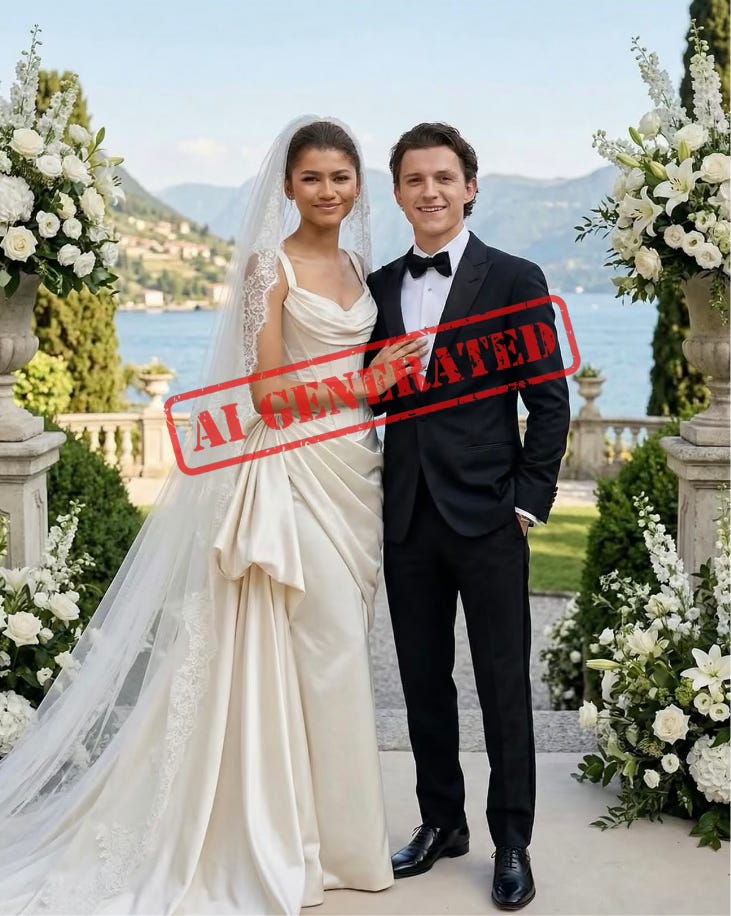
Zendaya then appeared on Jimmy Kimmel Live! to promote her new film The Drama, a dark comedy about a couple whose relationship unravels days before their wedding. When the photos came up, her response was warm, a little amused, and perfectly calibrated: “Babe, they’re AI.”
She then revealed ”exclusive wedding footage” that turned out to be a clip from The Drama with Holland’s face edited over her co-star Robert Pattinson’s. The crowd loved it. So did the internet. And The Drama opened in theaters the next day.
This isn’t just a celebrity story. It is a case study in how AI and the attention economy can work together to manufacture moments that are profitable, plausible, and impossible to prove. It is also a template that influencers use to sell products, political campaigns use to control narratives, and corporations use to manage crises. The only thing that changes is what's being sold.
The wrong question
When something like this happens, the instinct is to ask: did they plan this? It is the wrong question — not because the answer doesn't matter, but because the system is specifically designed to make that question unanswerable. That unanswerable quality isn't a flaw in the system. It is the point. A more useful question is this: who benefits, and how consistently do convenient things happen to benefit them at convenient times?
At the time the AI photos went viral, Zendaya and Holland had the following in the pipeline:
The Drama — April 3, 2026
Christopher Nolan’s The Odyssey (both of them) — July 17, 2026
Spider-Man: Brand New Day (both of them) — July 31, 2026
Euphoria, third and final season (Zendaya) — April 12, 2026
Dune: Part Three (Zendaya) — December 18, 2026
This is one of the most commercially loaded years either of them has ever had. When the volume of product is that high, sustained public attention isn’t a nice-to-have. It’s revenue. Every week that Zendaya and Holland stay in the cultural conversation is a week that moves ticket sales.
Into this context, a “spontaneous” chain of events unfolded. On March 1, 2026, Zendaya’s longtime stylist Law Roach made a comment while on the red carpet at the Actor Awards show strongly implying the wedding had already happened. Roach is not a friend who talked too much at a dinner party. He is a professional who has managed Zendaya’s public image for years, operates under confidentiality agreements, and was speaking at a press event where every word is on record. “Slipping” in that environment requires a specific kind of decision. Forty-eight hours later, AI wedding photos attributed to a self-described “digital creator” named Juan Regueira Rodríguez were posted and spread rapidly across social media, generating 12 million likes and 17,000 comments. Zendaya then addressed it all on late night television, during the press tour for a film literally about a wedding crisis, turning the moment into a promotional bit in real time.
Every element has a plausible innocent explanation. Roach could have slipped. The digital creator could be a genuine fan. The Kimmel conversation could have been unscripted.
Plausible deniability, when it appears this consistently and this conveniently, is not an accident. It is architecture.
Where AI changes the game
The photos were attributed to Juan Regueira Rodríguez, described as a digital creator. Here is what cannot be determined: whether that account belongs to a real independent creator who acted alone, a real person who was approached and compensated, or a fake account with no real person behind it. In 2026, all three are equally viable. None are verifiable by a general audience. For context, 12 million likes is not a number that typically finds an unknown digital creator’s post by accident. That ambiguity is one of AI’s most useful features, for anyone who understands how to use it.
A fabricated photo used to require resources, leave traces, and involve enough people that accountability remained at least theoretically possible. Now it requires a prompt and a few minutes. The barrier to manufacturing a viral moment and the barrier to disguising the origins of one have essentially collapsed at the same time, which means the tools that the attention economy has always used to manufacture consent, desire, and engagement can now be deployed faster, cheaper, and with far less accountability than at any prior point. The celebrities, studios, and PR firms who benefit from that system are not sitting on the sidelines watching it happen. They are adaptive, well-resourced, and paying close attention to what works.
This is the pattern
The specifics — Zendaya, Holland, a wedding, an AI image — are almost beside the point. What matters is the structure underneath: a convenient story emerges with a plausible organic origin, generates massive engagement, and benefits specific commercial interests at a specific time, responded to in a way that extends the story's life rather than ending it. Because nothing can be proven, the cycle closes without accountability. This is the attention economy — not in the abstract, but right here, in something you probably saw in your feed. And it does not stay in celebrity culture. Influencer product launches run the same play. So do political news cycles and corporate PR. The stakes are just higher when the product being sold isn't a movie.
The next time a story feels almost too convenient, don’t ask whether it was planned. Ask who needed it to happen. The answers won’t always be provable. But the habit of asking is how the system loses its grip on you.
If this reframed something for you, send it to someone who needs to see it.